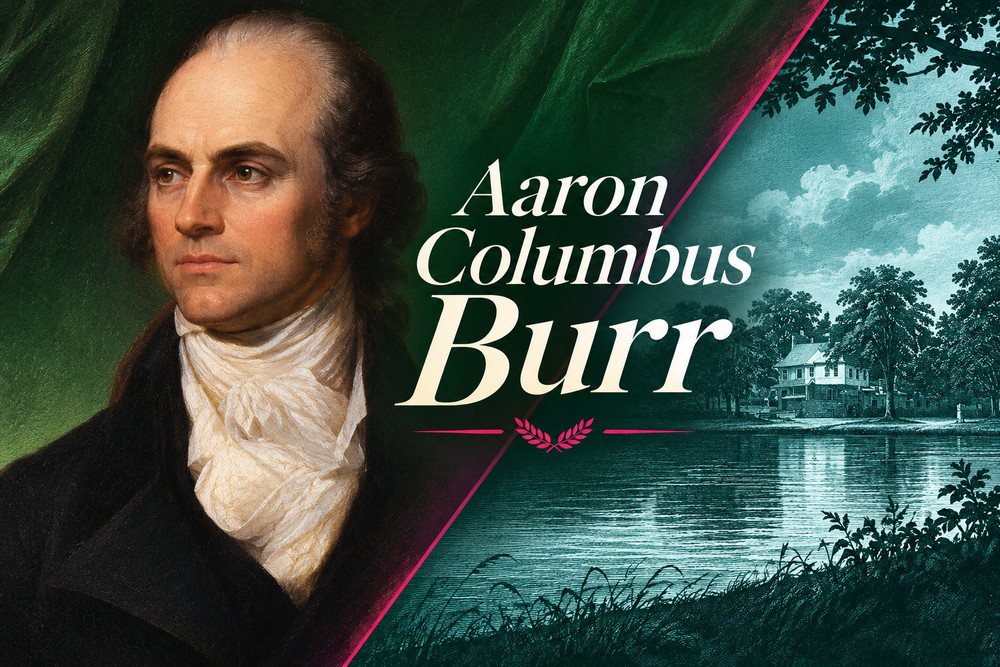
From France to an American childhood
France was the starting point for a childhood move to the United States under Aaron Burr’s guardianship. Born on 15 September 1808, Aaron Columbus Burr reached America as a boy, usually dated to around 1815 or 1816. The year remains unsettled, and Paris is a possible birthplace rather than a certainty. That journey preceded his New York career in gold, silver, diamonds, and imported jewelry by many years.
His early name appears as Aaron Burr Colombe or Aaron Burr Columbe. The elder Burr, who lived in Europe from 1808 to 1812, arranged the boy’s education and treated him as a godson. He also became his adoptive father. Whether adoption formalized a biological relationship is still unknown; the shared name cannot settle that question.
A different explanation made the child the son of a French count, variously called Verdi de Lesle or de Lisle. It remains a story attached to his childhood, not established parentage. His mother’s identity is unknown. I read the move to America as the clearest event in these early years: a child entered Burr’s care, even though the circumstances of his birth remain incomplete.
The Burr household before adulthood
By the time Aaron Columbus was growing up, his guardian had served as the third vice president of the United States. Military service, the fatal duel with Alexander Hamilton, and a treason trial also belonged to the elder Burr’s past. Those events explain the public weight of the surname, but they describe the guardian’s life, not the boy’s accomplishments.
Dates rule out one recurring confusion. Theodosia Bartow Prevost Burr, the vice president’s first wife, died in 1794, fourteen years before Aaron Columbus was born. She was not his mother. Her daughter, Theodosia Burr Alston, was born in 1783 and disappeared at sea early in 1813 after sailing from South Carolina.
No meeting between Theodosia Alston and Aaron Columbus is established. On the usual chronology of his arrival, she had already died before he reached America. Calling her his half-sister also depends on the unproven claim that the elder Burr was his biological father. Charles Burdett, another adopted and reputedly biological son, has a more direct place alongside him in the adoptive family.
The elder Burr died in 1836. Aaron Columbus was then an adult, so their relationship had lasted beyond the years of childhood care and education. Its private character is harder to describe than its duration.
Mary Coutant and a household already begun
Marriage to Mary Coutant brought Aaron Columbus into a household with three children. Mary was John Sneden’s widow; Mary Ann Sneden, Susan Emily Sneden, and John G. Sneden became Burr’s stepchildren. His responsibilities as a husband therefore included children from an earlier marriage as well as those associated with his own marriage to Mary.
Three children are named for the couple: Aaron Hippolyte Burr, Elizabeth C. Burr, and Eleanora F. Burr. Eleanora’s life lasted less than six months, from 30 May to 16 November 1831. Elizabeth’s dates are not clearly established. The names survive more fully than the details of their childhoods.
Mary died in 1851. Burr later married Adelia M. Burr, born on 20 January 1815. Adelia outlived him, dying on 15 December 1885.
| Topic | Detail |
|---|---|
| From France to an American childhood | Born on 15 September 1808, Aaron Columbus Burr reached America as a boy, usually dated to around 1815 or 1816. |
| The Burr household before adulthood | Theodosia Bartow Prevost Burr, the vice president’s first wife, died in 1794, fourteen years before Aaron Columbus was born. |
| Mary Coutant and a household already begun | Burr later married Adelia M. Burr, born on 20 January 1815. |
New York goldwork and an artist son
In New York, Burr combined craft with trade. He worked as a jeweler, goldsmith, and silversmith and became a substantial jewelry merchant and importer. Gold and silver were part of his working life, alongside diamonds and imported ornaments. These occupations give his adult biography a practical center separate from the unresolved question of his birth.
Artistic work continued in a different form through Aaron Hippolyte. His son copied John Vanderlyn’s likeness of the elder Aaron Burr, and the resulting painting belongs to the Princeton University Art Museum. The connection is specific: an artist reproduced the likeness of the man who had raised his father. To my mind, that object makes the relationship between three generations easier to grasp than the surname alone.
Business did not proceed without setbacks. In 1858, a buyer failed to pay for property Burr had sold. Retirement from the jewelry trade is generally placed around 1862, but another commercial undertaking was already taking shape before then.
An August offer in British Honduras
In August 1860, James Grant offered Burr property in British Honduras. The proposal included land at Stann Creek, a Belize city lot, and mahogany works, with a price of $65,000. That sum was an asking price for a business opportunity. It does not establish Burr’s personal wealth.
The venture also became connected to a proposed settlement for freed people. Working with Anna Ella Carroll, Burr sought Abraham Lincoln’s backing for the Lincoln Colony. Funding never came. The proposed colony remained unrealized, while Burr and Grant formed the American Honduras Company to export mahogany.
This later undertaking broadened the scope of his commercial interests from jewelry to overseas land and timber. The distinction between the two projects matters: a failed appeal for colony funding and a mahogany export company were related developments, but the company’s formation did not mean the settlement had been established.
FAQ
How certain is the relationship to Vice President Aaron Burr?
Adoption is established. Biological paternity is possible but unproven, so relationships that depend on that paternity must remain conditional.
Can either of the elder Burr’s wives be named as his mother?
No mother has been established. Theodosia Bartow Prevost Burr died before his birth, and Eliza Bowen Jumel cannot be established as his mother.
What is known about his death and burial?
Aaron Columbus Burr died in Manhattan on 27 July 1882. A stone at Coutant Cemetery in New Rochelle names Aaron C. Burr and Adelia M. Burr. A burial entry lists Woodlawn. The burial location remains unresolved.