Fifty cents and a journey to California
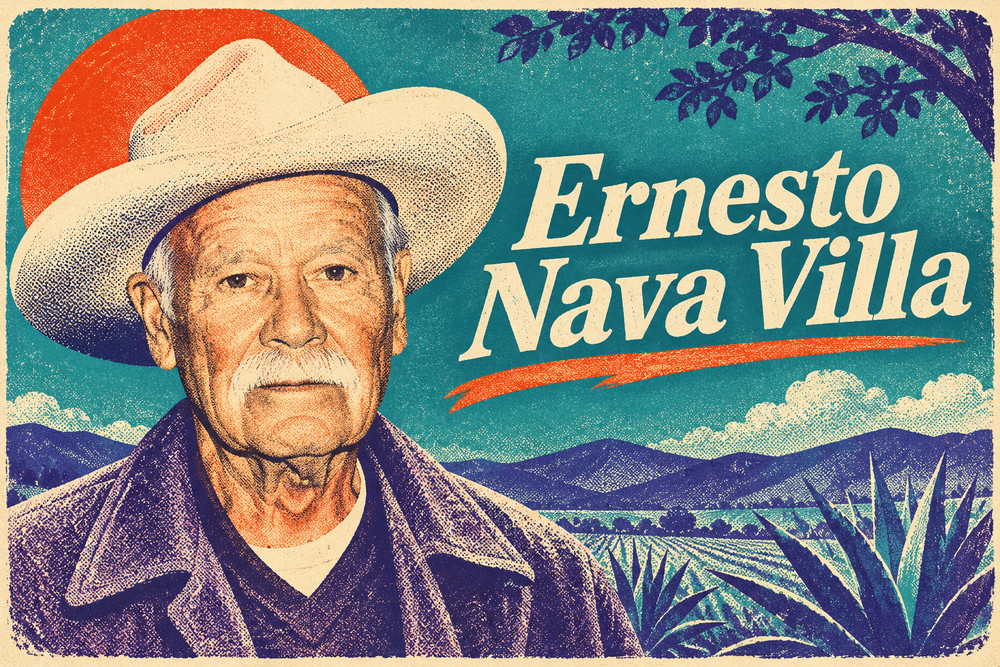
Samuel Nava remembered his father arriving in California at about 19 with just 50 cents. In his telling, Ernesto Nava Villa stopped in Los Angeles before finding crop picking work in the Central Valley. The amount belongs to a son’s recollection, but the route introduces the occupations and places that occupied much of Ernesto’s adult life.
Fields came first, followed by factories, shipyards, construction, and eventually plastering and contracting. Long before audiences welcomed him as a man who said he was Pancho Villa’s son, Ernesto earned his living through physical work. Ernesto and his children maintained that he was related to the family.
The plastering trade draws my attention to a practical connection between generations: Samuel and his brother Benny both worked in it, carrying forward an occupation their father practiced until about age 80.
Inez joins him in the West
Inez C. Nava, also known as Inez Chavez Uranga, joined Ernesto in California in 1936 or 1937. His mother, Macedonia Ramírez, followed several months later. By 1939, the family was living in Pescadero.
The next major move took them to Russell City, near Hayward, in 1942 or 1943. The year differs between accounts, but the attractions were practical and communal: Ernesto had shipyard work, and the family attended an Apostolic church nearby. Russell City became a setting for his businesses as well as his home life.
Samuel recalled a store, a restaurant, and a garage. He said his father’s generosity contributed to business difficulties because Ernesto gave too much away. This was a son’s explanation of how the ventures struggled, rather than a detailed account of their finances. Alongside those enterprises, plastering became Ernesto’s enduring trade.
Ernesto and Inez were married for 58 years. She died before him. Their years together connected the migration from New Mexico with the much longer California chapter.
Macedonia and the name Nava
The family’s account places Ernesto’s birth in Nazas, Durango, Mexico, on 4 July 1915. The family consistently observed his birthday on that date in July.
On 7 June 1917, according to the family chronology, Macedonia took her young son to Las Cruces, New Mexico. She feared that enemies of Pancho Villa would harm him. This move preceded Villa’s assassination in Parral on 20 July 1923 by six years; it was not a flight following his death.
Macedonia supported herself through domestic work. Ernesto recalled her telling him during childhood that Villa was his father and warning him to say nothing. He was often described as seven or eight at the time, although recollections differ about his exact age. He said he never met Villa.
Even the surname carries competing explanations. One family account identifies Juan Pablo Nava as the friend who helped Macedonia and Ernesto reach Las Cruces and later became Ernesto’s stepfather. Another describes a helpful friend named Nava without a marriage. Ernesto also explained the change as his mother giving him her name. These versions leave the circumstances unresolved; Nava was the surname he used while establishing himself in the United States.
| Topic | Detail |
|---|---|
| Inez joins him in the West | Ernesto and Inez were married for 58 years. |
| Macedonia and the name Nava | Ernesto recalled her telling him during childhood that Villa was his father and warning him to say nothing. |
| From a guarded account to festival appearances | By summer 2002, Ernesto was being introduced at a Chihuahua festival as Villa’s son. |
Children across several branches
The children named within Ernesto’s marriage to Inez were Raquel Eva Myers, Samuel Nava, Elizabeth Rodriguez, Ernesto Nava Jr., Eunice Perez, Saul Nava, Tarcila Zuniga, Benny Nava, and Eli Manuel Nava. The family also remembered three deceased children from that marriage.
Edwina Tarrant, Grace De La Riva, Rosie Ferrall, Aurelio Nava, and Raul Nava were named separately as other children Ernesto fathered. Aurelio died before him. Keeping those branches distinct avoids assigning all the children to Inez.
By Ernesto’s death, the family counted 31 grandchildren, 49 great grandchildren, and four great great grandchildren. Raquel worked as a school secretary. Samuel combined plastering with business and community involvement around Hayward, while Benny also pursued plastering. Their occupations broaden the portrait of a family whose public recognition eventually became closely associated with one ancestral claim.
From a guarded account to festival appearances
The disclosure happened in stages. Family recollections place its emergence between the late 1980s and the late 1990s, with different relatives remembering different moments. Raúl helped bring the account to a wider audience and accompanied Ernesto on visits to Mexico.
By summer 2002, Ernesto was being introduced at a Chihuahua festival as Villa’s son. Invitations and appearances extended across Mexico and California. He spoke at the Weekes Branch of Hayward Public Library on 6 October 2007 and attended the Steinbeck Festival in Salinas in 2008.
His account also reached film audiences through the 2006 documentary Pancho Villa, la Revolución no ha terminado and the 2009 short Pancho Villa’s Last Son. The documentary concerned Villa and surviving witnesses more broadly; the short focused directly on Ernesto.
The library appearance brings his two public identities together, as I understand them: a man whose working years were rooted in the Hayward area was now addressing a local audience about the childhood account he had carried from Mexico. Public acceptance and physical resemblance, however, did not establish his parentage.
FAQ
Who raised Ernesto Nava Villa?
His mother, Macedonia Ramírez, raised him after their move to Las Cruces. She was the person he credited with telling him that Pancho Villa was his father.
Did he have a personal relationship with Pancho Villa?
Ernesto said they never met. His belief in the relationship came from his mother’s account, and the biological connection remains unconfirmed.
When and where did Ernesto die?
He died of natural causes in Castro Valley, California, on 31 December 2009, aged 94. Funeral services were held in Union City on 11 and 12 January 2010, followed by burial at Chapel of the Chimes in Hayward.